


Organizations today are investing significantly in workforce development. According to ATD's
Building High-Performing Service Teams in the AI Era: Why Human Capability Will Define Customer Experience
Mohit Malik,
General Manager – Service & Delivery Excellence
31 July 2026
The Future of Customer Service Is Not AI. It's AI-Powered People.
Customer service has always been a defining moment of truth between an organisation and its customers. Every interaction—whether resolving a complaint, answering a question, handling a complex issue, or delivering proactive support—shapes perceptions of the brand far more powerfully than any marketing campaign.
Today, those moments of truth are changing rapidly.
Artificial Intelligence (AI), automation, predictive analytics, conversational interfaces, and AI agents are transforming how organisations deliver service at an unprecedented pace. Customers now expect immediate responses, personalised experiences, seamless interactions across channels, and consistent service regardless of when or how they engage.
At the same time, organisations face mounting operational pressures. Service teams must manage increasing case volumes, rising customer expectations, persistent talent shortages, growing cybersecurity concerns, and continuous technology change—all while improving productivity and controlling costs.
The challenge is no longer simply delivering faster service.
It is delivering better service.
This shift is redefining what it means to build high-performing service teams.
Contrary to popular perception, the organisations leading customer experience today are not those replacing people with AI. They are redesigning service around a partnership between human capability and intelligent technology. AI is increasingly handling repetitive tasks, surfacing insights, recommending next-best actions, and automating routine workflows, allowing service professionals to focus on empathy, judgement, relationship building, and solving complex customer problems.
Salesforce’s latest State of Service report reflects this transformation. Based on insights from more than 6,500 service professionals across 40 countries, the research shows that customer service has entered a new phase where AI is no longer viewed simply as a productivity tool but as an operational partner. Nearly 79% of service leaders believe investment in AI agents is essential to meeting current business demands, while 69% of organisations already use at least one form of AI within their service operations.
Yet perhaps the report’s most important finding is not about technology.
It is about people.
While AI adoption continues to accelerate, organisations increasingly recognise that technology alone cannot create exceptional customer experiences. Instead, the greatest competitive advantage comes from enabling service professionals to spend less time on administrative work and more time solving customer problems, building trust, and creating meaningful relationships.
This finding aligns with a broader shift occurring across organisations worldwide.
McKinsey’s State of Organizations 2026 argues that high-performing organisations are moving beyond isolated technology initiatives towards integrated organisational systems where leadership, talent, operating models, culture, and technology evolve together. Sustainable organisational performance no longer depends on adopting the latest digital tools alone; it depends on building adaptable workforces capable of continuously learning and responding to change.
Deloitte reaches a similar conclusion in its Global Human Capital Trends 2026. As AI becomes embedded across enterprise operations, the differentiating factor is no longer access to technology but the ability to combine human judgement, creativity, emotional intelligence, and ethical decision-making with AI capabilities. Organisations that redesign work around this partnership will outperform those that treat AI purely as a cost-reduction initiative.
The implications for customer service are profound.
For decades, service excellence was measured largely through operational efficiency—average handling time, ticket closure rates, first-response times, and adherence to service-level agreements. While these metrics remain important, they no longer capture what customers value most.
Today’s customers expect organisations to understand context, anticipate needs, personalise interactions, resolve issues quickly, and demonstrate empathy throughout the customer journey.
These expectations cannot be achieved through automation alone.
Nor can they be delivered solely through exceptional employees working without intelligent technology.
Instead, service excellence increasingly depends on organisations building teams where people and AI complement one another.
Microsoft’s latest Work Trend Index describes this transition as the emergence of a new model of work where humans increasingly manage, collaborate with, and direct AI agents while focusing their own efforts on higher-value activities that require critical thinking, creativity, communication, and relationship management. Rather than replacing employees, AI reshapes the nature of work itself.
The same evolution is becoming evident across customer service.
Routine customer enquiries.
Password resets.
Order status requests.
Appointment scheduling.
Conversation summaries.
Knowledge retrieval.
Administrative documentation.
These activities are increasingly being supported—or fully handled—by AI.
Meanwhile, human service professionals are focusing on complex problem-solving, emotionally sensitive interactions, cross-functional collaboration, customer advocacy, and long-term relationship building.
Salesforce’s research demonstrates this shift clearly. Service professionals working alongside AI report greater productivity, stronger career prospects, improved job satisfaction, and increased opportunities to develop new skills. More importantly, AI enables service representatives to dedicate more attention to high-value customer interactions rather than repetitive administrative work. Organisations using AI agents also expect measurable improvements in customer satisfaction while reducing service costs, customer wait times, and case resolution times.
This changing landscape demands a fundamentally different approach to building service teams.
Hiring skilled professionals alone is no longer sufficient.
Investing in AI platforms alone is equally insufficient.
High-performing service organisations require a holistic approach that integrates workforce capability, leadership, learning, organisational culture, technology, and customer-centric design into a single operating model.
At Luminedge Advisory, we believe the future of service excellence will not be defined by organisations that deploy the most sophisticated AI.
It will be defined by organisations that build the most capable service teams—teams equipped to leverage AI responsibly, adapt continuously, solve increasingly complex customer challenges, and deliver exceptional experiences that technology alone cannot replicate.
The question facing organisations, therefore, is no longer:
“How can AI improve customer service?”
The more important question is:
“How do we build service teams that enable people and AI to perform at their best together?”
The answer lies not in technology alone, but in reimagining workforce capability for the AI era.
Why High-Performing Service Teams Need More Than Technology
Artificial Intelligence is reshaping customer service faster than any technology before it. Intelligent virtual assistants can answer routine enquiries, predictive AI can anticipate customer issues before they arise, conversational AI can maintain context across channels, and agentic AI can automate workflows that once required significant manual effort.
These capabilities are transforming service operations.
However, they are not redefining service excellence.
People are.
One of the biggest misconceptions surrounding AI is that better technology automatically creates better customer experiences. In reality, organisations investing heavily in AI often discover that technology amplifies existing capabilities rather than replacing them. If service processes are fragmented, knowledge is inconsistent, or frontline employees lack confidence and decision-making capability, AI simply accelerates those weaknesses.
Technology can improve efficiency.
It cannot replace judgement.
It can recommend actions.
It cannot fully understand human emotions.
It can retrieve knowledge instantly.
It cannot build trust with a frustrated customer.
It can automate routine work.
It cannot create a service culture.
This distinction is becoming increasingly important as customer expectations continue to evolve.
According to Salesforce’s State of Service report, 82% of service professionals agree that customer expectations are higher than ever before, while service representatives spend less than half of their working time (46%) interacting directly with customers, with the remainder consumed by administration, documentation, meetings, and internal responsibilities. At the same time, organisations expect customer case volumes to continue increasing over the coming year.
The implication is clear.
Organisations do not simply need more technology.
They need service teams capable of delivering exceptional experiences despite growing complexity.
This is why leading organisations are changing the conversation.
Instead of asking,
“How can AI replace service representatives?”
they are asking,
“How can AI make service professionals more effective?”
That subtle shift changes everything.
The Competitive Advantage Is Becoming Human Capability
For years, organisations viewed customer service primarily as an operational function.
Success was measured through efficiency.
Average handling time.
Call volumes.
Response time.
Ticket closure.
Cost per interaction.
These metrics remain important.
However, they are no longer sufficient to differentiate one organisation from another.
Today, customers remember something entirely different.
They remember whether someone understood their problem.
Whether the organisation resolved the issue quickly.
Whether they were treated with empathy.
Whether someone took ownership.
Whether the interaction felt effortless.
These experiences are created through human capability supported by intelligent technology—not technology operating independently.
Deloitte’s Global Human Capital Trends 2026 argues that as AI becomes embedded across organisations, sustainable competitive advantage increasingly depends on uniquely human capabilities such as critical thinking, ethical judgement, collaboration, adaptability, creativity, and emotional intelligence. Rather than replacing people, AI shifts human work towards activities where these capabilities create the greatest value.
Customer service represents one of the clearest examples of this transition.
Routine enquiries are increasingly handled by AI.
Complex conversations continue to require people.
Customers may happily interact with an AI agent to check an order status or reset a password. Yet when dealing with financial concerns, healthcare decisions, service failures, emotional complaints, or high-value purchases, they still expect empathy, reassurance, accountability, and nuanced judgement.
Those expectations cannot be automated.
They must be developed.
AI Is Changing Roles—Not Eliminating Them
One of the most encouraging findings emerging from recent research is that AI is creating opportunities for service professionals rather than simply reducing headcount.
Salesforce found that among organisations already using AI:
- 83% of service representatives believe AI improves their career prospects.
- 82% say working with AI has helped them develop new skills.
- 81% report higher productivity.
- 80% say AI has reduced job stress.
- 79% believe AI has increased their job satisfaction.
Perhaps even more importantly, service representatives working alongside AI spend proportionally more time resolving complex customer issues while AI manages routine interactions.
This reinforces an important principle.
The future role of the service professional is evolving from information provider to trusted problem solver.
Instead of answering repetitive questions, employees increasingly become advisors, coaches, relationship builders, and decision-makers.
Microsoft’s Work Trend Index describes this broader workforce evolution as a shift towards human-AI collaboration, where employees increasingly orchestrate AI agents while focusing on work requiring creativity, communication, critical thinking, and customer engagement. AI changes how work is performed rather than diminishing the importance of people.
For service leaders, this has profound implications.
Recruitment alone is no longer enough.
Technology deployment alone is not enough.
Organisations must continuously develop the capabilities that enable people to perform effectively alongside AI.

Capability Has Become the New Service Differentiator
Historically, organisations competed through products.
Then they competed through price.
More recently, customer experience emerged as a key differentiator.
Increasingly, competitive advantage is shifting once again.
It is moving towards workforce capability.
Every organisation can purchase similar CRM platforms.
Every organisation can implement AI assistants.
Every organisation can automate routine workflows.
What competitors cannot easily replicate is a workforce that consistently demonstrates sound judgement, customer empathy, collaboration, adaptability, commercial awareness, digital confidence, and continuous learning.
These capabilities are developed deliberately over time through leadership, coaching, culture, and structured capability-building initiatives.
McKinsey’s State of Organizations 2026 highlights that organisations achieving sustained performance invest not only in technology but also in organisational health, leadership effectiveness, talent development, learning, and workforce adaptability. High performance emerges when these elements reinforce one another rather than operating independently.
Brandon Hall Group echoes this perspective, arguing that AI should be embedded into work rather than layered on top of existing processes. The greatest value comes when technology, organisational context, governance, workforce capability, and continuous learning operate together to improve business performance rather than simply increasing productivity.
This is particularly relevant for customer service.
High-performing service teams are not defined by the sophistication of their technology stack.
They are defined by how effectively people use technology to create better customer outcomes.
Beyond Skills: Building Service Capability
Many organisations continue to focus their service development efforts on technical skills alone.
Product knowledge.
Process training.
System navigation.
Compliance.
These remain essential.
However, the AI era demands a broader definition of capability.
High-performing service teams increasingly require the ability to:
- Build trust during emotionally complex customer interactions.
- Collaborate effectively with AI systems and digital tools.
- Interpret customer context rather than simply follow scripts.
- Make sound decisions in situations where automation reaches its limits.
- Learn continuously as technologies and customer expectations evolve.
- Translate data and AI recommendations into meaningful customer actions.
These are not isolated competencies.
Together, they create organisational capability.
Capability enables consistency.
Consistency builds customer trust.
Trust drives customer loyalty.
And customer loyalty ultimately drives business performance.
The organisations that recognise this shift earliest will build service teams capable of delivering exceptional customer experiences regardless of how technology continues to evolve.
That is why the conversation should move beyond “implementing AI in customer service.”
The more important challenge is building service organisations where human capability and artificial intelligence strengthen one another.
It is this combination—not technology in isolation—that will define the next generation of service excellence.
Building High-Performing Service Teams: The Luminedge Service Excellence Framework
Technology has fundamentally changed how customer service is delivered.
It has not changed what customers value.
Customers still expect organisations to understand their needs, resolve problems efficiently, communicate with empathy, and build confidence during every interaction. Artificial intelligence can accelerate many aspects of service delivery, but it cannot independently create trust, ownership, accountability, or genuine customer relationships.
That responsibility continues to rest with people.
This is why organisations that consistently deliver exceptional customer experiences do not view AI as the centre of their service strategy.
They place workforce capability at the centre.
Technology then becomes an accelerator.
At Luminedge Advisory, we believe high-performing service organisations are built by aligning six interconnected dimensions that together create sustainable service excellence.
Rather than focusing solely on technology or training, the framework recognises that exceptional customer experiences emerge when leadership, people, processes, culture, learning, and AI evolve together.
The Luminedge High-Performance Service Framework
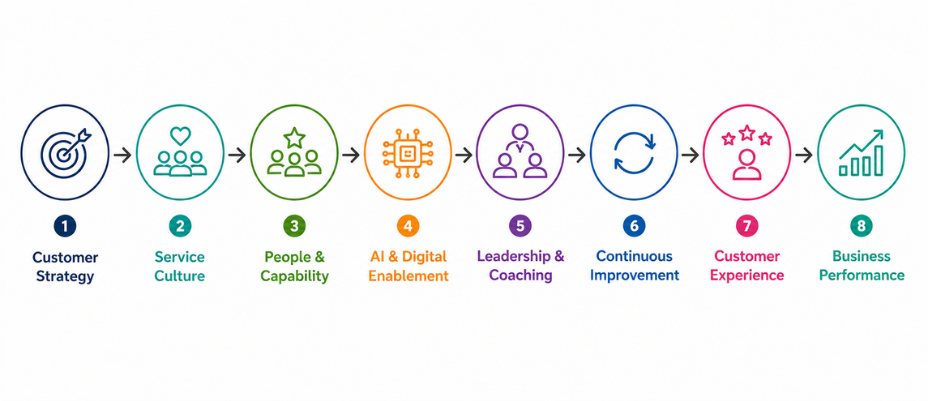
Unlike traditional service transformation programmes that begin with technology implementation, this framework begins with customer value and ends with measurable business outcomes.
Each stage strengthens the next, creating a continuous cycle of capability development and service improvement.
1. Customer Strategy: Start With Customer Outcomes
Many organisations still design service operations around internal efficiency.
Processes.
Systems.
Cost reduction.
Ticket volumes.
Service-level agreements.
While operational excellence remains essential, high-performing service organisations begin with a different question:
“What experience do we want customers to remember?”
Every capability investment, technology decision, learning intervention, and operational improvement should support that answer.
Salesforce’s research highlights that customer expectations continue to rise, with 82% of service professionals agreeing that expectations are higher than they were just a few years ago. Customers increasingly expect personalised, proactive, and seamless interactions across every service channel.
Customer strategy therefore becomes the foundation upon which service capability is built.
2. Service Culture: Build Ownership, Not Scripts
Technology can standardise service delivery.
Culture determines how employees respond when situations fall outside predefined processes.
High-performing service cultures encourage employees to:
- Take ownership of customer outcomes.
- Exercise sound judgement.
- Collaborate across functions.
- Learn from customer feedback.
- Continuously improve service delivery.
This shift is particularly important in the AI era.
As routine enquiries become increasingly automated, the conversations reaching frontline teams are becoming more complex, emotionally sensitive, and commercially significant.
Employees therefore need confidence—not just compliance.
Service culture enables that confidence.

3. People and Capability: Develop Skills That AI Cannot Replace
Perhaps the greatest misconception surrounding AI is that technical capability alone will determine organisational success.
In reality, as AI assumes more routine work, uniquely human capabilities become even more valuable.
These include:
- Empathy
- Active listening
- Critical thinking
- Problem solving
- Commercial awareness
- Adaptability
- Collaboration
- Ethical judgement
- Customer advocacy
These capabilities cannot be developed through one-off customer service training programmes.
They require structured learning journeys, coaching, practice, feedback, and continuous capability development.
Salesforce’s findings reinforce this perspective. Service representatives working alongside AI report stronger career prospects, higher productivity, increased job satisfaction, and greater opportunities to develop new skills, suggesting that AI enhances the role of service professionals when organisations invest in capability development.
The future service professional is therefore not someone who competes with AI.
It is someone who knows how to collaborate with it.
4. AI and Digital Enablement: Make Technology an Enabler, Not the Experience
Artificial intelligence has become one of the most significant enablers of service transformation.
Predictive AI can anticipate customer needs.
Generative AI can draft responses.
Conversational AI can maintain context across multiple channels.
Agentic AI can automate repetitive workflows while supporting complex decision-making.
However, organisations frequently make the mistake of treating AI implementation as the transformation itself.
Technology should simplify work.
It should reduce administrative burden.
It should surface better insights.
It should improve decision quality.
It should allow employees to dedicate more time to customers.
According to Salesforce, organisations with unified service platforms are 1.4 times more likely to report highly successful AI implementations than organisations operating with siloed systems. Likewise, 88% of service leaders are prioritising technology integration to support their AI initiatives, highlighting that connected data and workflows are critical to unlocking AI’s full potential.
Technology therefore becomes most valuable when it strengthens human capability rather than attempting to replace it.
5. Leadership and Coaching: The Multiplier of Service Excellence
Even the most capable employees require effective leadership.
Managers increasingly perform a role that AI cannot.
They build confidence.
Coach behaviour.
Provide context.
Encourage learning.
Support wellbeing.
Reinforce organisational values.
In high-performing service organisations, managers move beyond monitoring operational metrics.
Instead, they coach teams to improve customer conversations, strengthen decision-making, develop emotional intelligence, and adapt to increasingly complex customer interactions.
McKinsey’s research consistently highlights leadership effectiveness and organisational health as essential characteristics of sustained high performance. As AI reshapes work, leaders become increasingly responsible for helping employees embrace continuous learning, navigate uncertainty, and integrate new technologies into everyday work.
Technology may automate supervision.
It cannot replace leadership.
6. Continuous Improvement: Capability Is Never Finished
Customer expectations continue to evolve.
AI capabilities continue to improve.
Products change.
Markets shift.
Customer behaviour adapts.
High-performing service organisations therefore avoid viewing capability building as a one-time initiative.
Instead, they establish continuous learning ecosystems where customer insights, operational data, employee feedback, coaching conversations, and business outcomes are continuously analysed to improve workforce capability.
Brandon Hall Group argues that organisations derive the greatest value when learning becomes embedded within work rather than separated from it. AI-supported learning, contextual guidance, and continuous capability development enable organisations to respond more effectively to changing business demands while strengthening workforce performance over time.
Service excellence is therefore not achieved through a single transformation programme.
It is sustained through continuous capability development.
From Service Capability to Business Performance
When these six dimensions work together, organisations begin to see measurable improvements that extend far beyond customer service operations.
Customer satisfaction improves because employees solve problems more effectively.
Employee engagement increases because routine work is reduced and people focus on higher-value interactions.
Operational efficiency improves because AI automates repetitive tasks while employees apply judgement where it matters most.
Learning becomes more targeted because capability investments are linked to customer outcomes.
Leadership becomes more effective because managers spend less time supervising processes and more time developing people.
Ultimately, service excellence becomes a business capability rather than simply a customer support function.
This is the real opportunity presented by AI.
Not replacing service professionals.
Empowering them to create experiences that customers remember, trust, and return for.
References
- Salesforce – State of Service, Seventh Edition.
- McKinsey & Company. State of Organizations 2026.
- Deloitte. Global Human Capital Trends 2026.
- Microsoft. Work Trend Index 2026.
- Brandon Hall Group. The Intelligent Learning Organization.
- Brandon Hall Group. Building AI Around Work, Not Just Workflows.

Organisations across industries are investing heavily in artificial intelligence, automation,

In today's highly competitive business environment, organisations can no longer
Explore Our Solutions
Learning Experiences We Enable
From leadership capability and workforce readiness to AI literacy and behavioral transformation, Luminedge Advisory designs learning experiences that combine contextual relevance, practical application, and scalable enterprise delivery.